

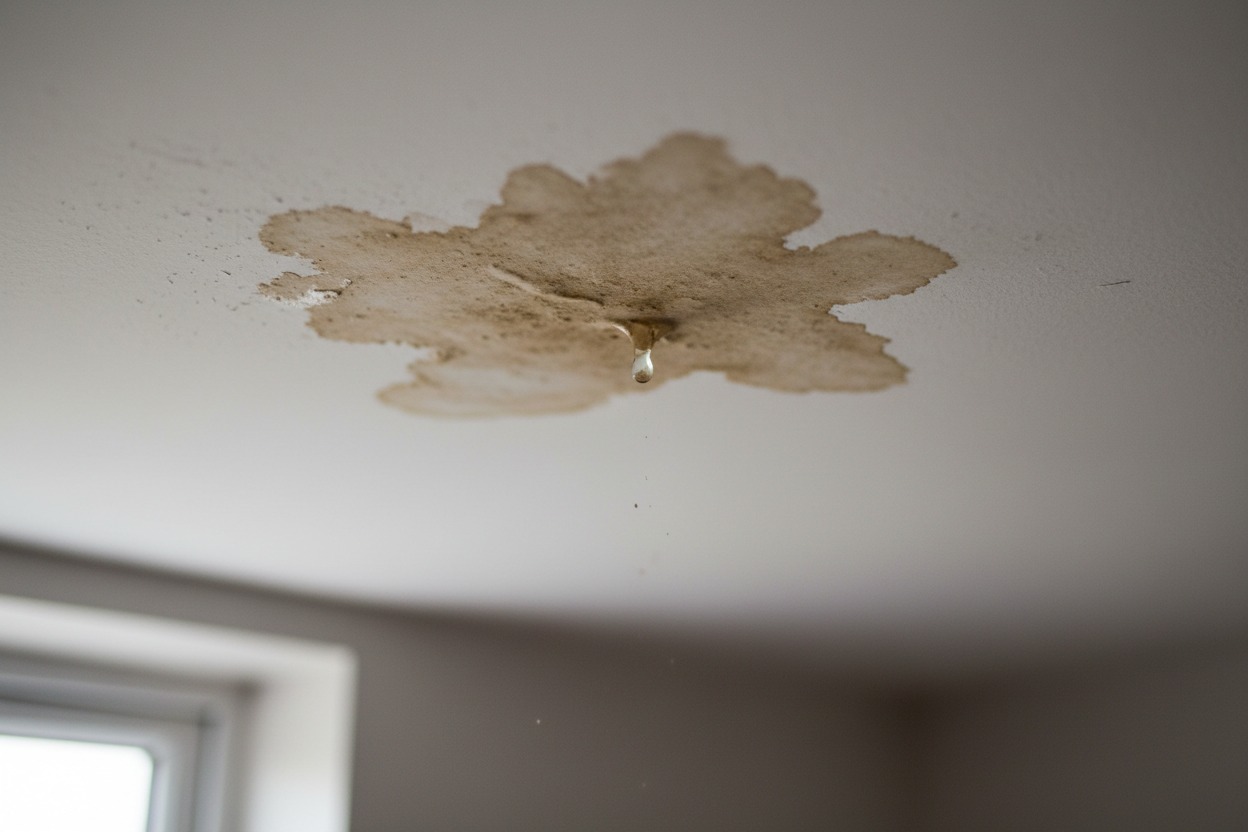
Bedroom ceiling, a brown patch about the size of a coaster. Last Tuesday it wasn’t there. By Friday, after that evening storm, the edge had crept out another inch and the middle felt damp when you pressed it with a finger. If that’s roughly where you are, you’re probably asking two things at once: where is this coming from, and do I really have to get somebody to climb up there?
Here’s the good news. Most of what helps tonight happens on the floor, not the roof. Dry the room, slow the water, work out roughly where it starts. The part that goes wrong is the climb. Someone finds a likely spot, smears tar on it, and the drip carries on, because the stain and the hole are almost never in the same place. There’s attic in between, sometimes a lot of it. So below: tonight’s to-do list, how to find the real entry point, and how to repair a leaky roof without making it worse.
Short answer
To repair a leaky roof, catch the water first: bucket, towels, drain any bulging ceiling. Then find where it really gets in, which is rarely right above the stain. That fix happens on the roof, and it’s usually flashing, a cracked vent boot or a few lifted shingles. Tar goes right off wet shingles. Keep any temporary roof repair to what you can reach safely.
What your stain is telling you
Read the stain before you touch anything. It tells you more than you’d think.
| What you see | What it usually points to | Safe first check | How urgent |
|---|---|---|---|
| Faint brown ring, dry to the touch | An old or one-time leak, possibly already stopped | Photograph it, trace the edge in pencil, look again after the next rain | Watch it |
| Ring that grows after every rain | An active slow leak, often flashing or a vent boot | Look in the attic directly above the stain with a flashlight | Soon |
| Steady drip during a storm | An open entry point: missing shingle, failed flashing or a cracked pipe boot | Catch the water, protect the floor, note which side of the house it is on | Today |
| Ceiling that bulges or sags | Water pooled above the drywall, and the weight is building | Stay out from underneath and drain it safely | Immediately |
| Stain on a wall or along a ceiling corner | Wall or chimney flashing, or a window or dormer seam | Look at the outside of that wall from the ground | Soon |
| Leak only in wind-driven rain | A seam or vent that only fails when rain is pushed sideways | Write down the wind direction on the days it leaks | Soon |
| Musty smell, no visible stain | Hidden dampness in insulation or decking | Check attic insulation for dark, matted patches | Soon, mold risk |
| Daylight visible in the attic | A real gap in the roof covering | Mark where you see it from inside | Today |
Top half of that table? Treat it as a this-week job. A ring that grows after every rain means a quick patch won’t hold.
The first ten minutes
Forget the roof for ten minutes. Drag the couch to the other wall, roll up the rug, and put a bucket under the drip with a folded towel in the bottom. A bare bucket pings all night and splashes anyway. Electronics out of the room. Water finds the lowest spot, and that’s always where the nice furniture is.
A bulging ceiling is its own emergency. That bulge is water sitting on the back of the drywall, and a dinner-plate-sized one can hold a couple of gallons. It won’t hold forever. Put a bucket down, stand to one side, and poke a screwdriver through the lowest point. Feels wrong, I know. But one small hole beats the whole panel dropping at two in the morning.
Water near a light, a ceiling fan or a smoke detector? Flip that breaker before you go back in. Then grab your phone and take dated photos of the stain, the drip and the attic. A roofer gets a lot from them, and you’ll see how fast it’s spreading.
Why the stain is rarely under the leak
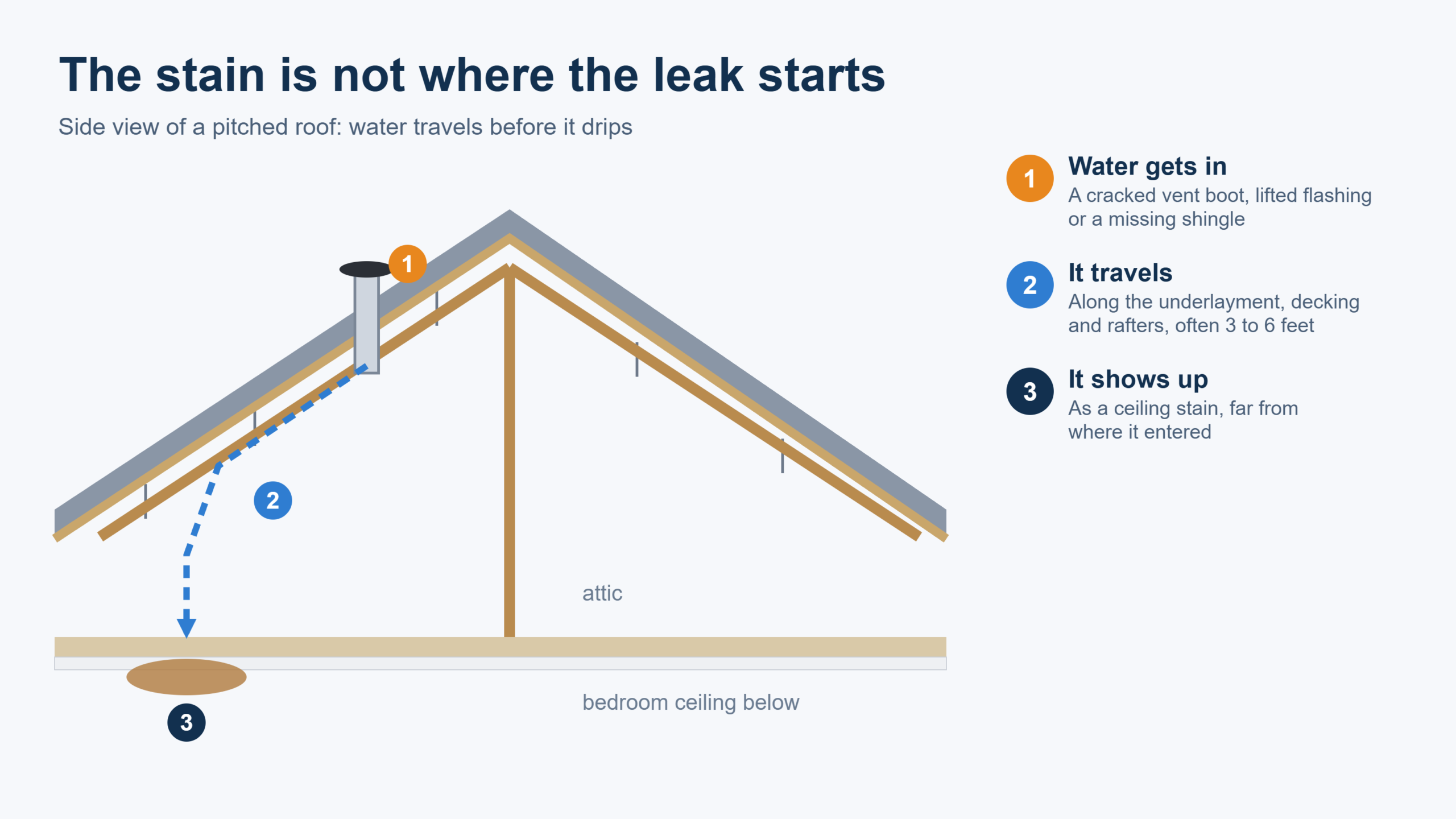
Most people figure the hole is right over the stain. It rarely is. Rain slips under a shingle, lands on the black underlayment and runs downhill along a rafter, sometimes five or six feet, until it finds a gap in the drywall tape. Entry point and stain can sit on opposite sides of the attic.
A common version of this mistake goes like this: somebody patches the shingles right above the stain, the next rain comes, and it’s the same drip. The actual entry point turned out to be a plumbing vent a few feet uphill.
The places roofs actually leak
Shingles out in the middle of the roof are rarely the first thing to fail. The details are, because they depend on sealant, metal and rubber that all age faster than asphalt.
| Weak point | Why it fails | What it can look like from inside |
|---|---|---|
| Flashing (chimney, walls, dormers) | Metal or sealant at the joint pulls away or rusts | Stain on a wall or near the chimney, often only in hard rain |
| Plumbing vent boots | The rubber collar around the pipe cracks in the sun | A ring or drip near a bathroom or kitchen |
| Damaged or missing shingles | Wind lifts or tears them, or they curl with age | A spot leak on the lower part of the slope, sometimes daylight in the attic |
| Valleys | Water concentrates where two slopes meet and debris holds moisture | A long stain running along a ceiling line |
| Exposed or popped nails | Nail heads work up through shingles over time | Small scattered drips, often after temperature swings |
| Skylights | The seal or flashing around the frame ages | A drip or ring around the frame |
| Gutters | Backed-up gutters push water under the roof edge | Staining along the exterior wall or ceiling edge |
| Ridge and roof vents | Wind-driven rain gets past the vent | A drip only in storms with strong wind |
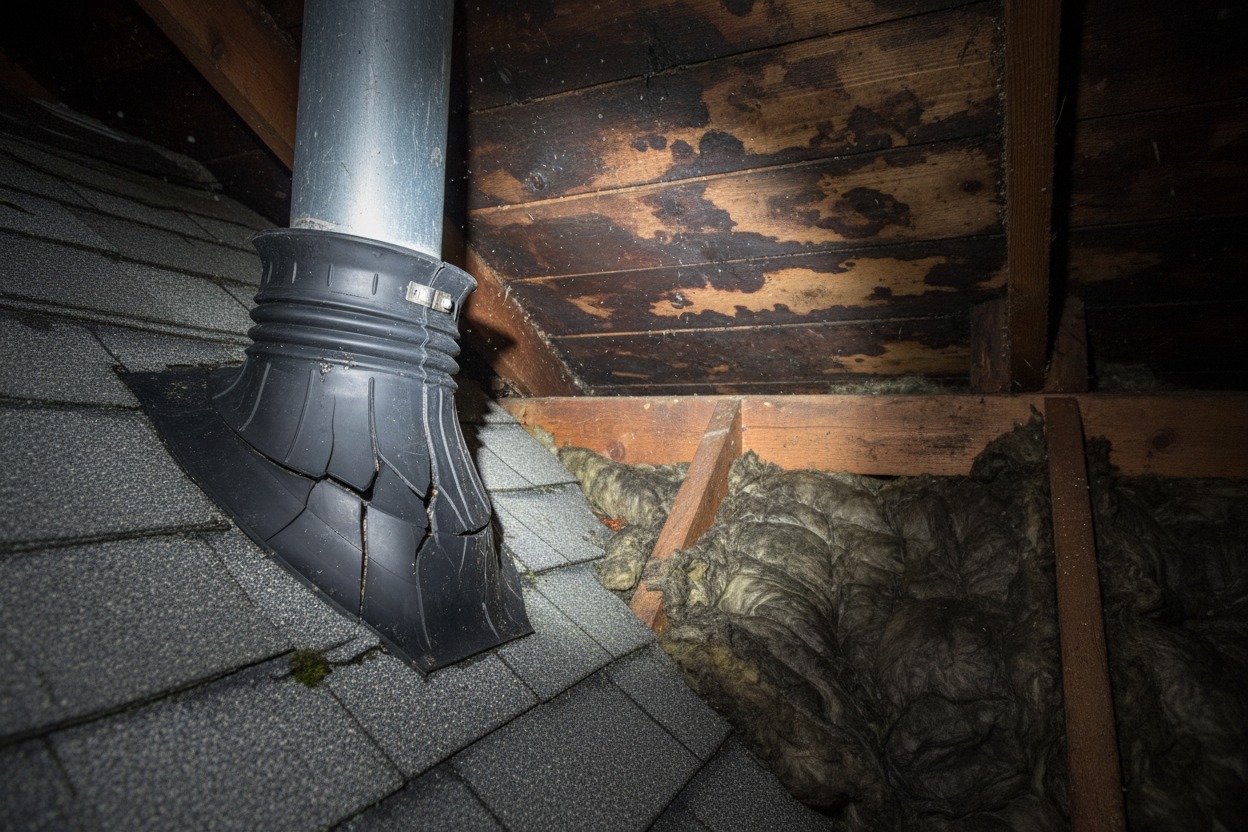
One thing to rule out first: condensation. Warm damp air in a stuffy attic hits cold decking and drips, and plenty of people blame the roof. Drips on a cold morning with no rain? That’s your clue.
Tracing it from the attic
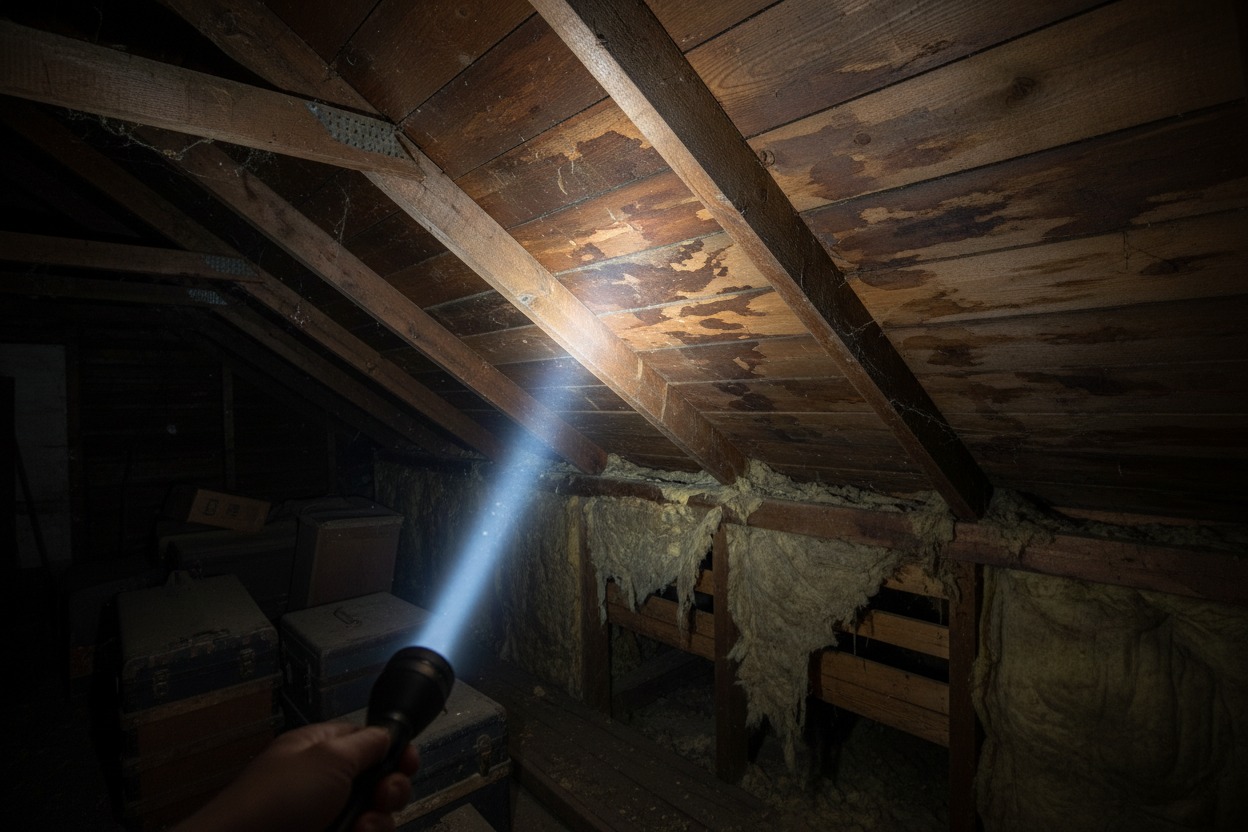
Nobody likes the attic in July. Hot, itchy, balancing on joists. Go anyway, flashlight in hand, for twenty minutes. Start above the stain, look for a dark streak under the decking, and follow it uphill. Water leaves a trail. Rusty nail tips, flat dark insulation, a pinprick of daylight. When the streak ends, measure to something fixed, the chimney or a vent pipe, so you can find the same spot outside. Tape on the rafter and a photo with a tape measure in frame saves the roofer real time.
From the ground, binoculars on a dry afternoon will show missing or curled shingles, a lifted flashing edge, a cracked vent boot, a patch of bare nails. Dark grit in the gutters and at the foot of the downspouts is shingle granules. Lots of it usually means the roof is near the end.
Don’t climb up to look, though, especially on a wet or steep roof. More on that below.
How to repair a leaky roof for now: temporary measures that help
A temporary roof repair has one job, which is to buy a few days. It isn’t the fix. Some measures are reasonable for a homeowner and others belong to a roofer.
| Measure | What it does | Safe for a homeowner? | The limit |
|---|---|---|---|
| Bucket, towels, plastic sheet over belongings | Protects the inside | Yes | Does nothing for the roof |
| Plastic sheeting over attic insulation or stored items | Keeps the wet from spreading | Yes | Only if you can reach it safely |
| Draining a bulging ceiling | Prevents a collapse | Yes, with care | Treats the symptom only |
| Tarp over the damaged area | Keeps most rain out | Mostly no. It has to be anchored properly and the work happens on the roof | A loose tarp can tear shingles and come loose in the next storm |
| Roofing cement on a small crack | Seals a minor gap | Only on a low, dry, reachable section | Won’t bond to wet shingles and can hide the real source |
| Caulk or silicone on shingles | Looks like a fix | Not recommended | Breaks down fast and can trap water |
| Spray-on sealant | Looks like a fix | Not recommended | Rarely reaches the actual entry point |
Most of the useful stuff in that table happens indoors. That’s on purpose.
Why DIY roof patches fail
Roofing cement needs a dry surface to grab. A leaking roof is wet by definition, so the stuff goes on, looks fine, and starts lifting a week later, usually right before the second storm. There’s another catch. If the patch happens to divert the water, the stain might dry out and you’ll think it worked, while the damage carries on out of sight.
Old shingles are more fragile than they look. Walk a fifteen-year-old asphalt roof and you can crack tabs and scrape off granules, which turns one leak into three. And the water isn’t waiting. Wet insulation stops insulating, decking softens, drywall can grow mold fast. The EPA’s guide to mold, moisture and your home says water-damaged areas should be dried within 24 to 48 hours to prevent mold, and that’s hard to manage while the roof keeps letting water in.
Then there’s the risk that has nothing to do with leaks. Falls are the leading cause of construction deaths, even for trained crews, according to NIOSH’s fact sheet on falls from roofs and ladders. A wet slope with a sealant bucket in one hand is exactly that situation. No ceiling stain is worth it.
A roofer also looks at the whole system at once: decking, underlayment, flashing, shingle age. A tube of sealant only covers one spot.
When a patch isn’t enough
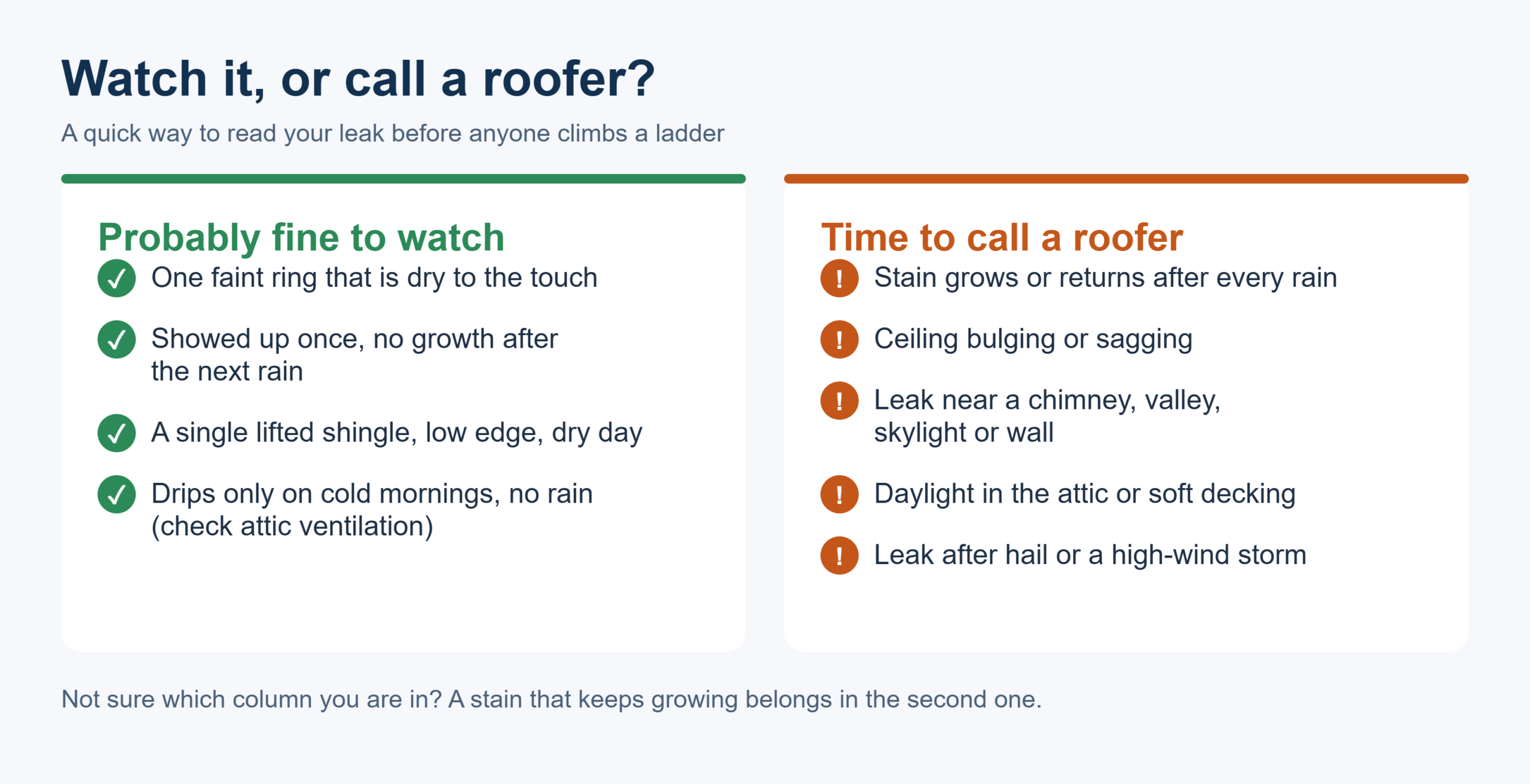
One lifted shingle on an otherwise healthy roof can be a quick fix. Most leaks aren’t that. Call someone soon if the stain keeps growing, if you’ve patched it once and it came back, if there’s more than one, if the ceiling sags, or if it’s near a chimney, skylight, valley or wall. Daylight in the attic or soft, spongy decking counts too. After hail or a high-wind storm, don’t wait. Around Gastonia, roofing help in Gastonia, NC shows how to reach a local roofer who’ll find the real entry point and tell you plainly if it’s a repair or something bigger.
What to tell the roofer
Before you call, jot down a few things. Where the stain is and about how far from a chimney, vent or wall. Whether it leaks in heavy rain, only with wind, or after every rain. How old the roof is and whether it’s been repaired. Photos of the stain, the attic and anything you can see from the ground. And whether the stain is growing, and how fast. You’ll get a better answer on the first call.
A Gastonia note
Gastonia weather doesn’t help. Summers are sticky, storms show up fast, and now and then a tropical remnant parks overhead all afternoon. Wind-driven rain finds spots a gentle shower skips, so if yours only leaks with wind, check flashing, vents and the ridge before blaming shingles. Heat matters too. Vent boots and old sealant bake for months, and the first big storm after a dry spell finds whatever cracked.
After the repair
Once it’s fixed, let the house dry. A fan or dehumidifier helps. Pull out any insulation that stayed soaked. Hold off painting until the ceiling’s dry all the way through, then use stain-blocking primer, because ordinary paint lets the ring show through. Watch the spot over the next two or three rains. If the ring comes back, something got missed.
Frequently asked questions
Can I fix a leaking roof myself?
A little. You can limit the damage and handle a small, low, dry-weather item. The lasting fix means finding the real entry point and working from the roof, and that needs the right gear.
Can you repair a roof leak from the inside?
Only for a while. You can catch water, protect insulation and drain a bulging ceiling. The leak itself gets fixed outside, where the water gets in.
How long can a roof leak before it causes real damage?
Quicker than people think. Insulation and drywall can stay wet for days, and the EPA says to dry things within 24 to 48 hours to stop mold. A slow leak does less harm each day, but it never stops on its own.
Should I put a tarp on the roof myself?
I’d skip it. A tarp has to be anchored properly, usually from a wet slope, and a loose one tears shingles and blows off in the next storm. If you feel you need one, call a roofer.
Is it a roof leak or a plumbing leak?
Check the weather. Roof leaks show up during or after rain. Plumbing leaks keep going on a dry day and tend to sit near bathrooms, kitchens or supply lines.
Is it safe to cut into a bulging ceiling?
Yes, carefully. Stand to the side, bucket underneath, one small hole at the lowest point so it drains slowly. It stops a bigger collapse.
Why did my roof only start leaking after a big storm?
The storm didn’t make the weak spot. It found one that was already there, like old flashing or a worn vent boot.
The bottom line
A leak gives you a little time and a lot of clues. Use the time on the room. Use the clues to find where the water gets in. Treat anything you stick on the roof as a bridge, not the repair. Knowing how to repair a leaky roof includes knowing where your part ends. If the stain keeps growing or sits near a chimney, vent or valley, get someone up there. For storm damage and leak repairs, a local roofing service in Gastonia is the next step.
Leave a Reply